
After a nearly two-year legal fight, Ogden Dunes officials have dropped plans for a stone revetment along the Lake Michigan shoreline, Save the Dunes Executive Director Betsy Maher said.
The stone revetment would have extended the existing barrier on the tiny town’s eastern side to protect homes from erosion.
Ogden Dunes Town Council President Scott Kingan could not be reached for comment Saturday.
In June 2023, the Conservation Law Center, representing Save the Dunes, challenged the Indiana Department of Natural Resources permit for the project. The DNR didn’t delineate Lake Michigan’s natural ordinary high-water mark, the boundary between private property and public land, the Conservation Law Center argued, so public access to the beach would have been negatively affected.
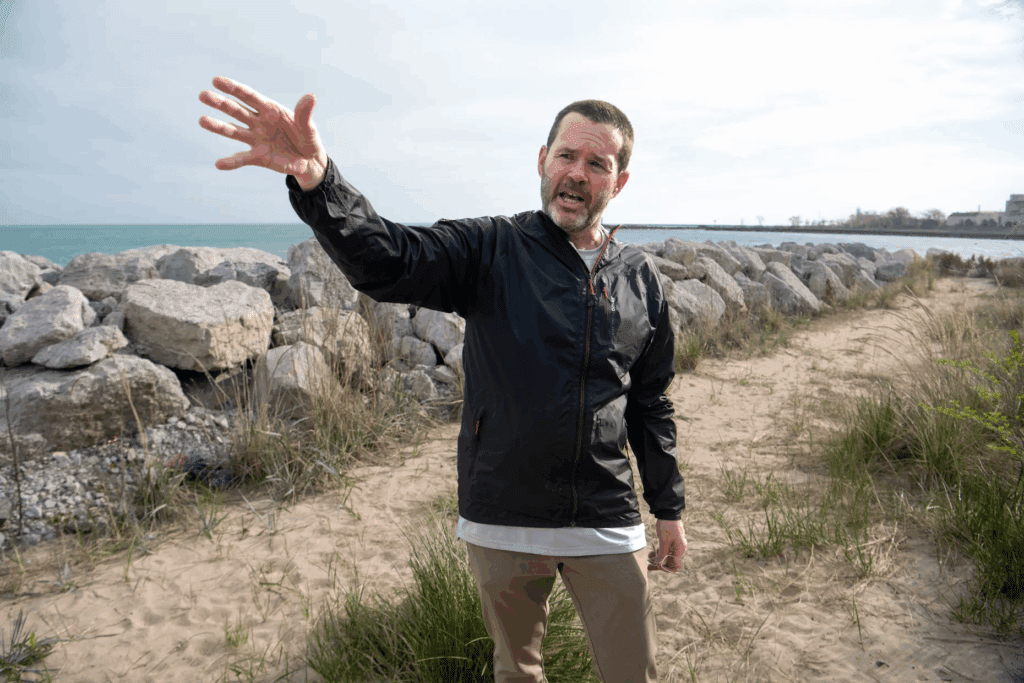
(Andy Lavalley/for the Post-Tribune)
Former state Sen. Karen Tallian, of Ogden Dunes, had authored a state law to codify a 2018 Supreme Court ruling in a Long Beach case, Gunderson v. State, that also dealt with public access to the beach, Maher noted Friday.
The ruling is literally a landmark; it marks the line between private land and public land.
Maher said Save the Dunes is “thrilled” that Ogden Dunes formally abandoned its proposed project, but the Conservation Law Center and Save the Dunes are weighing options for the future.
“We will continue to pursue all legal avenues to ensure DNR correctly applies the state’s public trust laws and regulations intended to safeguard Lake Michigan for current and future generations of Hoosiers,” Conservation Law Center Executive Director Christian Freitag said in a news release Friday. “Under Indiana law, DNR is tasked with protecting our shared public trust resources, and we intend to make sure the agency does its job.”
The town’s erosion problem is exacerbated by the Port of Indiana, which blocks the natural flow of sand from east to west along Lake Michigan’s southern shore.
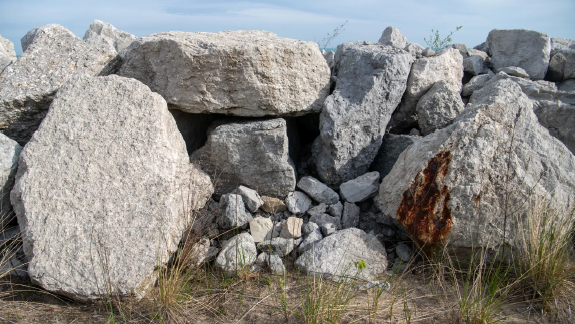
(Andy Lavalley/for thePost-Post-Tribune)
The stone revetment on the town’s eastern side was added when the lake level was high and an emergency was declared. But with the lake level lower, Maher said, “now is the time that we can have discussions about both short- and long-term solutions.”
She wants to restore the natural flow of sand, even in a manmade way, protecting access to the beach.
That could include an intake on the east side of the port and an outtake on the west side, allowing the sand and water to flow through. As it is, sand is building up on the port’s east side, Boater’s Beach, and causing the port to require periodic dredging, Maher said.
That sand brought up from dredging is clean sand and could be used to replenish the Ogden Dunes beach, placing the sand offshore and letting the current give it a push where we do want it, she said.
Or maybe an artificial reef or some kind of speed bumps to capture sand along the beach could be added in the lake.
“We just have to fix the core problem,” Maher said. “Step 1 is not destroying the beach before we have a chance to fix the problem.”
“They don’t need rocks; they need sand,” Maher said.
In April, Kingan walked along the beach to show sand is starting to pile up in front of the existing revetment. That barrier wasn’t cheap. It cost $10 million, with each homeowner paying $500,000 to protect their homes. The project, now abandoned, was pegged at $2 million, he said in April.
With the lake level so low, this is a good time to get everyone involved in working on a long-term solution.
Doug Ross is a freelance reporter for the Post-Tribune.