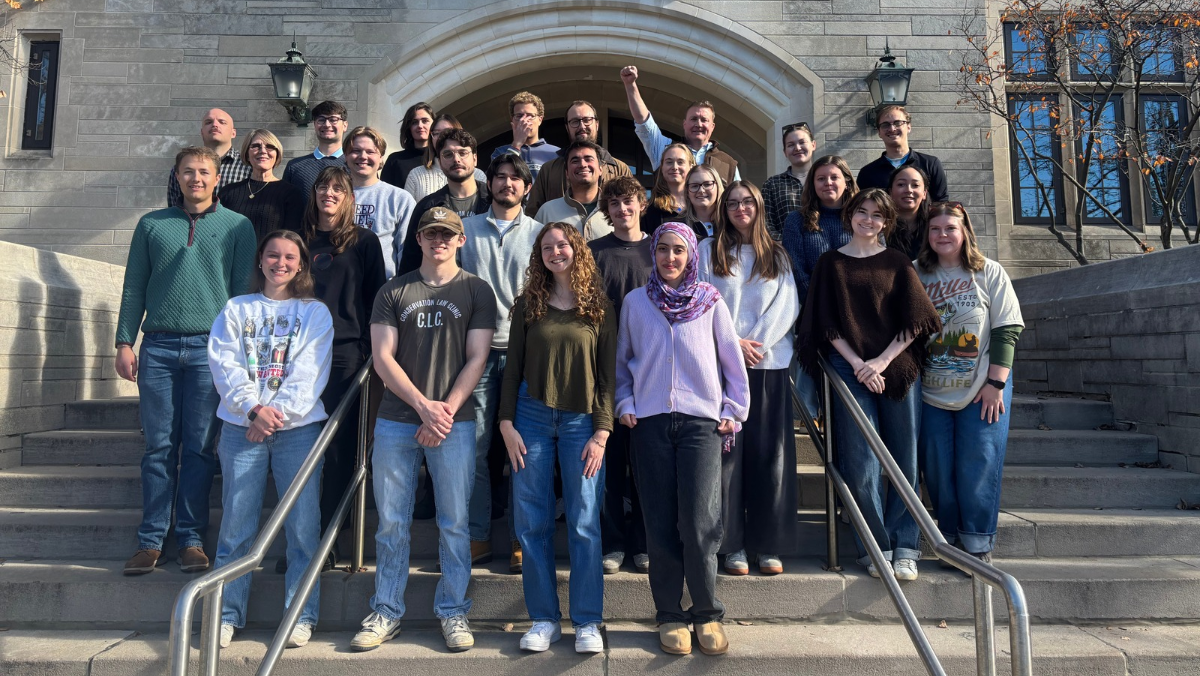
At the start of the semester, many of this fall’s clinic students had never drafted a complaint, advised a nonprofit board, or worked through a legal problem alongside scientists. On November 19, they presented work that had done each of those things for real clients.
Strengthening organizations on the front lines
Several teams worked behind the scenes for conservation nonprofits. For George Rogers Clark Land Trust, students revised bylaws and policies and built a conservation easement checklist. For Gorilla Doctors, they began a two-semester memo defining the organization’s mission and legal structure, reading French-language documents, sorting out international compliance requirements, and collaborating closely with scientists.
This type of work is behind-the-scenes, and students said that was part of what made it satisfying. They saw how much a small, committed staff carries, and how much stronger an organization becomes when its governing documents match the way it actually runs.
Building new legal tools
Other teams took on questions without clear answers. One group studied how Indiana could create a state agricultural land easement program to slow the loss of farmland to development. Their 64-page memo traced past attempts in the Indiana General Assembly and compared programs in six other states. Legislators changed strategies while they worked, which one student described as “shifting sands under your feet.” The team’s takeaway was candid: legislation is hard.
Two teams drafted complaints for potential litigation. For most, it was their first complaint. They worked through which court to file in, how much science belongs in a pleading, how to proceed with an incomplete record, and how to build a novel claim with no clear precedent to lean on. Another team drafted an amicus brief to the Wisconsin Supreme Court on the public trust doctrine, testing how far old case law should govern public rights in shared waters today.
Making the law usable
The Citizens’ Guide to Zoning team faced a problem of translation. Local zoning is one of the clearest ways for Indiana communities to weigh in on data center proposals. But the process is opaque, and it varies across 92 counties and more than 1,000 townships. The students’ guide explains it in plain terms for people who want to know what they can do. The guide will be published in early 2027.
Clinic research can also grow well beyond a single semester. Last spring, students produced a 108-page report on human-wildlife conflict in East Africa. Over the summer and this fall, they refined it to about 50 pages, which they presented at the Indiana Journal of Global Legal Studies symposium in November. It is expected to be published in spring 2027. The students were honest about the limits of that work, too. Advising form a computer in the United States on complicated situations on the ground, one said, “feels like sitting in an ivory tower.” Knowing that is part of doing the work well.
Growing into attorneys
CLC attorneys and student teaching assistants helped teams turn sprawling questions into deliverables they could finish and shape several writers’ drafts into one voice. Students learned to represent clients they didn’t always relate to, and to make realistic recommendations within political realities. By the end, more than one student said they were starting to feel like “a little bit of an expert.” That confidence came the honest way – through hard work, honest feedback, and many, many drafts.
CLC is an independent, donor-supported nonprofit. Your support keeps hands-on legal education, and the public service tradition behind it, available to the next generation of conservation lawyers. Please consider donating today.