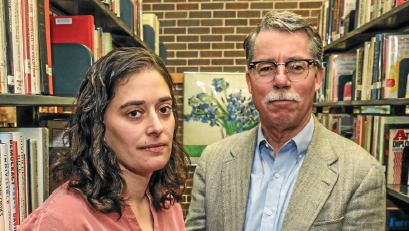
“I’ve always personally been interested in the environment,” Rachel Schwartz, an attorney at the Conservation Law Center, told The Times. “But what I’ve wanted to do in my career is support access to justice for people who have been in some way excluded or disadvantaged in our justice system. And I think in Northwest Indiana, there’s a way that I can bring those two interests together.”
The Bloomington-based nonprofit that she works for provides free legal services to advocacy groups and individual community members with environmental concerns.
Schwartz graduated from the University of Chicago law and public policy dual degree program in the spring and joined CLC through a University of Chicago Law School Public Service Fellowship.
The organization’s Northwest Indiana operation, which focuses on Gary, East Chicago, Hammond and Whiting, had previously been a one-man enterprise run by veteran attorney Michael Zoeller. Having Schwartz on board, Zoeller told The Times, has been a major step up for CLC’s capabilities in the Region.
Since joining CLC early last year, Zoeller has tackled a variety of local environmental issues. He is currently representing the activist and Gary resident Gary Lee in a lawsuit against the Little Calumet River Basin Development Commission.
Lee sued the commission in August 2025, alleging, among other claims, that the body’s then-ongoing lease agreement with Merrillville-based Maya Energy violated the commission’s statutory-defined purpose. The company planned to build a waste-to-feedstock processing facility on a plot of commission-owned land on 35th Avenue in Gary.
Lee also claimed that the commission had violated Indiana’s Open Door Law by discussing improper topics in closed executive sessions and that two of its members were legally ineligible for their seats.
A Lake County judge sided with the commission on all three claims, finding that the body did not break the law. Lee brought the case to the Indiana Court of Appeals, where the matter is awaiting a ruling.
The end of Maya Energy’s Gary development ambitions in October, which the company’s co-owner blamed on a noncooperative city administration, marked a significant victory for the project’s critics. It does not necessarily mean, however, that litigation on the subject is over.
On Oct. 23, the commission voted to terminate its agreement with Maya Energy, and Nov. 10, the body filed to have Lee’s appeal partially dismissed on the basis that his complaint about the lease had been rendered moot. In a response filed on Lee’s behalf, Zoeller wrote that the court should still rule on the issue “because it raises an issue of great public importance likely to recur.”
“It’s not just Mr. Lee,” Zoeller said. “There’s plenty of other people who care about making the commission more transparent and accountable and keeping it close to its statutory purposes.”
Litigation is only a small part of the work that CLC does. Much of Zoeller and Schwartz’s time is spent on lower-profile activities — fielding questions from concerned community members, reviewing environmental records and lobbying permitting authorities.
Last year, CLC joined a coalition of environmental groups working on behalf of East Chicago residents who sought stricter state oversight for a local waste processor with a history of violating environmental regulations. Schwartz, then a law student, participated in the effort as part of the University of Chicago’s Abrams Environmental Law Clinic. The Indiana Department of Environmental Management acknowledged the input it had received from the groups when it added more stringent provisions to a renewed operating permit for the facility.
On behalf of a group of Gary residents, Zoeller has been monitoring court proceedings surrounding an illegal junkyard on West 11th Avenue and drafting periodic reports to help demystify the sometimes arcane process. The city first sued Andy’s Truck & Equipment Company in 2005 for operating without proper zoning or a valid business license, kicking off a two-decade-long legal struggle with the company’s owner. In October, a bankruptcy court authorized the sale of the property and its stock of vehicle parts to a local developer.
Zoeller said that he has toured the site with its new owner and plans to keep abreast of its cleanup and redevelopment.
Earlier this month, Schwartz urged East Chicago’s Board of Zoning Appeals to exercise caution in its approach to an Illinois metal recycler’s bid to open a new facility in the city. Aurora-based Universal Metal Recycling asked the city to approve a special-use exception that would pave the way for a new recycling facility on Euclid Avenue. The site eyed by the company sits just south of George Washington Elementary School and Block Stadium and less than 1,000 feet from St. Catherine Hospital.
In a letter to the board, Schwartz urged the body to seek more information from the company before taking action, including the type of machinery that would be installed and the steps the company would take to control particulate emissions from a metal shredder.
“The Conservation Law Center does not oppose responsible development,” she wrote. “Rather, we work to promote community members’ conservation and environmental health goals. In this instance, we hope to support the continued use and enjoyment of invaluable community resources and to ensure the individuals and organizations we work with have enough information to participate meaningfully in the conversation.”
The East Chicago BZA ultimately voted to deliver an unfavorable recommendation on the item to the East Chicago Common Council, which will take a final vote on the matter later this month.
Though their focus is on northern Lake County, Zoeller said that he and Schwartz have occasionally provided guidance to those living further afield, including Porter County residents with environmental objections to new data center developments. He stressed that CLC is willing to hear out anyone interested in keeping their community clean and safe, and will provide support where possible.
“I do think there are a lot of folks who do have some concerns or have a question that we could provide some information, you know, and be a resource,” Zoeller said. “We’re not looking to do anything, right? Our job is to help other people make their environment better.”