
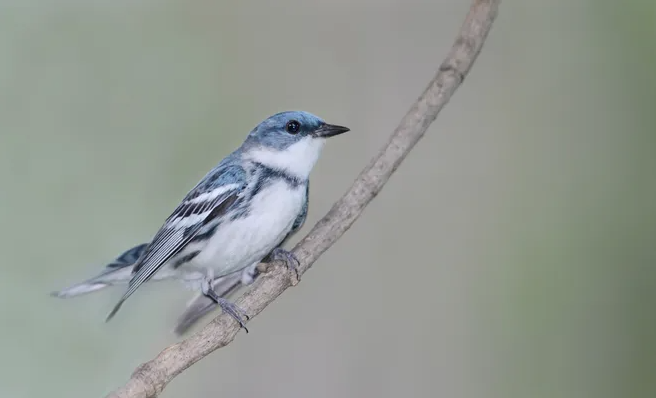
A little blue bird weighing the same as two nickels (about 9 grams) is bringing together numerous conservation groups in an effort to manage the hardwood forests in Brown County and parts of Monroe, Lawrence, Morgan and Bartholomew counties.
The cerulean warbler is a small bird on the state endangered list in Indiana and other states. Although it’s not currently listed as federally endangered, the species has lost 70%of is population in the last 50 years. Much of that is because the bird’s habitat has disappeared.
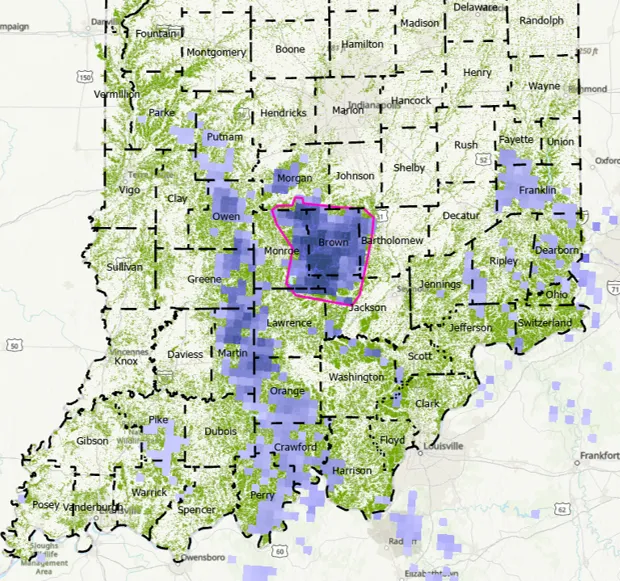
Indiana’s highest concentration of cerulean warblers during the breeding season is an area in five south-central Indiana counties, with Brown County as the central location. Because of that, the Southern Indiana Cerulean Warbler BirdScape, formed in March2025, is focusing its attention there.
Edward Oehlman, who works for American Bird Conservancy, is coordinator for the birdscape that includes state, national and international groups. Together they are beginning a three-year project to try and bolster the warbler’s population, which is currently about 500,000 worldwide.
Why does protecting the cerulean warbler matter?
“One, people should care because of what is happening with the cerulean warbler and birds in general,” said Matt Williams, director of conservation with the Sam Shine Foundation, a nonprofit conservation group based in Greenville, Indiana, that is currently the main financial donor for the project.
Williams explained that cerulean warblers are just one of the bird species with declining populations. More than 3 billion birds in the U.S. and Canada have disappeared. “It’s telling us something or a series of things are wrong,” he said, adding that’s a red flag and now is the time to figure out what’s happening.

Williams said many people enjoy birds, watching them and listening to them. “Life would be less sweet if we lost a lot of our birds.”
The Brown County hills area was chosen for the project because it’s the last remaining stronghold of breeding habitat for the warbler in Indiana, Williams explained.
Also, protecting the habitat for the cerulean warbler means other birds that live in the same habitat will benefit. That includes the eastern whippoorwill, which is listed as “near threatened,” the red-headed woodpecker as well as bats and wild turkey.
What will the project do in Indiana?
The Indiana portion of the project will be centered in Brown County, with a 200-acre project site in Brown County State Park, not far from Ogle Lake.
While benefitting birds, the project will also help the forest itself and the wildlife that live there, Williams said. With a number of conservation groups helping, small pockets of the forest will be opened up to allow sunlight to reach the ground and underbrush areas where the insects and caterpillars, food for cerulean warblers and other birds and wildlife, flourish.
After the small openings are created, it may take one to two years before the area near the ground is thriving, Oehlman said.
“Right now we’re working on creating demonstration sites,” he said. Those sites will be places where researchers can document the life of cerulean warblers and also bring people to show them what’s needed to benefit the warblers. The goal is to educate Hoosier landowners about ways they can improve wooded areas on their private land to increase the areas where the warblers can live.
Oehlman said there are about 400,000 acres of public land in south-central Indiana, including the Hoosier National Forest, the public areas near Lake Monroe and Camp Atterbury, where the cerulean warblers can live. But more than half of the area is private lands.
Giving ‘backpacks’ to the birds before they migrate
Before the cerulean warblers get far into their nesting season, researchers will put up mist nets in the normal flying paths the warblers take. The nets are not harmful to the birds but allow the researchers to put small “backpacks” on them that will provide information as they migrate, Oehlman explained.
The devices are barometric geolocators, which are tiny devices that are placed on the bird’s back using a backpack-style harness made of soft, durable ribbon that are fastens around the bird’s wings or legs. They are positioned on the lower back to decrease interference while the bird flies. The geolocators take a reading at a set interval, often about every 20 minutes, of the barometric pressure. That is an accurate way of determining where the bird has been when it’s lined up with the geolocator information.

The data isn’t available until after the warbler is caught again and the device removed. So far there are four devices that have been taken from birds after they’ve completed migrating from Indiana to their wintering grounds and back.
That information will provide information about the key areas where the birds stop while migrating, according to Sheela Turbek, science coordinator with the Central Hardwoods Joint Venture. Then efforts can be made to ensure those areas are protected.
Where does the project extend beyond the Brown County hills area?
The project’s scope ranges from the Brown County hills area, where cerulean warblers nest from late April to early September, down through Kentucky and Tennessee and into Central America, as the birds migrate to their wintering areas in the Andes Mountains, which stretch along the western coast of South America. The goal is to conserve areas along the whole range of the warbler’s habitat, said Kyle Brazil, director of Central Hardwoods Joint Venture.
In the U.S. cerulean warblers can be found in eastern and midwestern states, with the highest concentration in the Appalachian region — areas where there are deciduous forests that have the necessary high treetops and openings below.

The project is working with partners in Costa Rica, one of the areas where the warblers stop to rest and eat, putting on weight and gaining strength before traveling into the Andes Mountains. Researchers know about the stop in Costa Rica because a few cerulean warblers were outfitted with another device to follow its flight path and it passed transmitters in Costa Rica that relayed the information to them.
The Andes’ range from Venezuela into Columbia, Ecuador, Peru, Bolivia, Chile and Argentina. Now researchers are trying to find local partners in the various countries to work with them on conserving the needed habitat areas.
“We’re trying to move from small random acts of conservation all over the habitat to more concentrated efforts in certain habitats,” Brazil said. That means protecting areas that are large enough to “make a difference but small enough that we can get the work done in an effective way,” as the groups work to build the “crucial mass of habitat” needed for the warblers to increase their numbers.
Contact Carol Kugler at ckugler@heraldt.com.